


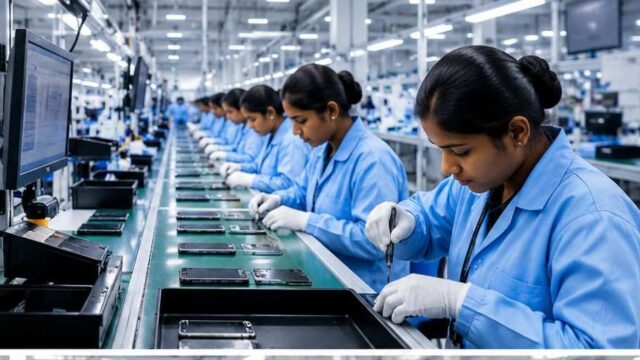
The Ministry of Electronics and Information Technology (MeitY) has notified the Mobile Phone Manufacturing Scheme (MPMS) with a budgetary outlay of ₹62,500 crore, aimed at strengthening India’s position as a global mobile phone manufacturing hub and deepening the domestic electronics supply chain.
The five-year scheme, which will run from FY27 to FY31, seeks to increase global competitiveness by expanding manufacturing scale, raising domestic value addition (DVA) and strengthening indigenous manufacturing capabilities.
The scheme also seeks to help Indian mobile phone brands build technological sovereignty, capture greater economic value and develop Indian-owned intellectual property, design and research and development capabilities.
Focus on Indian brands and intellectual property
Union Minister for Electronics and Information Technology Ashwini Vaishnaw said MPMS will provide a significant boost to Indian-owned mobile brands, intellectual property and product design.
The minister stressed that genuine Indian ownership of the brand, design and intellectual property would be central to the scheme.
He said the government would undertake a detailed evaluation to ensure that intellectual property being claimed under the scheme is genuinely Indian-owned. Non-fiscal and other support measures will also be developed in consultation with industry.
The government expects the scheme to encourage Indian companies to compete in global markets while creating additional employment opportunities.
Two target segments
MPMS has been structured around two target segments.
Target Segment 1 (TS1) will provide incentives for mobile phone manufacturing, while Target Segment 2 (TS2) will support Indian mobile phone brands.
The scheme will operate for five years from FY 2026-27 to FY 2030-31. Applicants under TS2 may receive a gestation period of one year.
For TS1, incentives will range between 2.25% and 5%.
Under TS2, Indian brands will be eligible for a 5% incentive, with an additional 3% incentive for Indian design and R&D. The scheme will also provide non-fiscal support to Indian brands.
An additional incentive of up to 1.5% will be available for domestic sourcing of key components and sub-assemblies under both target segments.
Applicants can include mobile phone manufacturers and Electronics Manufacturing Services (EMS) providers registered in India.
Sales and incentives payable to applicants will be computed on a brand-wise basis.
Building on PLI success
The new scheme follows the completion of the Production Linked Incentive Scheme for Large Scale Electronics Manufacturing (PLI-LSEM) on March 31, 2026.
The government said the PLI scheme played a catalytic role in establishing India as a global hub for mobile phone manufacturing and exports.
The MPMS is intended to sustain this momentum while shifting the focus further towards scale, domestic value addition, Indian brands, intellectual property and local sourcing.
India emerges as major mobile manufacturing hub
India has become the world’s second-largest mobile phone manufacturer by volume, with 99.2% of mobile phones used in the country now being manufactured domestically, according to the government.
Smartphones emerged as India’s largest exported product category in 2025, surpassing traditional leading export categories such as diesel fuel and cut diamonds.
The broader electronics manufacturing sector has also expanded sharply since FY2014-15, with production growing seven-fold and exports increasing eleven-fold, driven significantly by the government’s Make in India push.
The sector has emerged as a major employment generator, particularly for young workers from rural areas. Some electronics manufacturing facilities employ more than 5,000 people at a single location, while employment at some facilities has reached 20,000.
Deepening domestic value addition
With the ₹62,500 crore MPMS, the government is looking to move India’s mobile manufacturing ecosystem beyond assembly towards deeper domestic value addition and greater ownership of technology, design and brands.
The emphasis on domestic sourcing of key components, Indian design and R&D and Indian-owned brands is expected to help retain a larger share of the economic value generated by the mobile phone industry within the country.
The scheme also seeks to strengthen India’s participation in global electronics value chains while encouraging the emergence of Indian mobile brands capable of competing in international markets.