


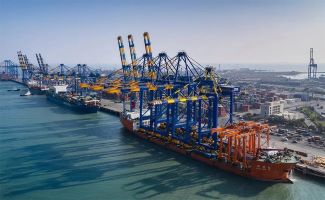
Adani Ports and Special Economic Zone Ltd (APSEZ) has emerged as the highest bidder and received the Letter of Award (LoA) for developing and operating two dry bulk berths at Paradip port in Odisha.
The project will add 18 million tonnes (MT) of capacity to APSEZ’s portfolio, taking its total capacity to 671 million tonnes per annum (MTPA). The addition will support the company’s target of reaching 1 billion tonnes of cargo throughput by 2030.
30-year concession to expand capacity
The project will be developed under the Public-Private Partnership model through a 30-year concession. APSEZ will develop the CQ-I and CQ-II berths with mechanised cargo-handling systems, deep-draft berths and large-scale storage infrastructure.
“The Paradip concession will strengthen APSEZ’s presence on the East Coast and expand our access to one of India’s most important industrial and mineral-rich hinterlands,” Whole-time Director and CEO, Ashwani Gupta, said.
Network expands to 16 ports
“With Paradip, APSEZ’s network grows to 16 ports and terminals across India’s 11,000-km coastline, strengthening our ability to deliver integrated port, logistics and marine solutions through the country’s most comprehensive transport infrastructure platform,” he said.
Located in a mineral-rich hinterland and surrounded by major steel plants, Paradip is India’s second-largest major port and an important gateway for bulk cargo. The new terminal will increase APSEZ’s ability to handle coal, limestone and other dry bulk commodities.
Focus on eastern industrial clusters
The capacity addition will expand APSEZ’s reach across industrial and manufacturing clusters in eastern and central India. It also comes amid high utilisation levels at ports along India’s East Coast and rising cargo demand.
Growing steel capacity in the hinterland and the government’s push to increase domestic coal production are expected to support cargo volumes. The project is also expected to help address regional port-capacity constraints and support industrial growth.