


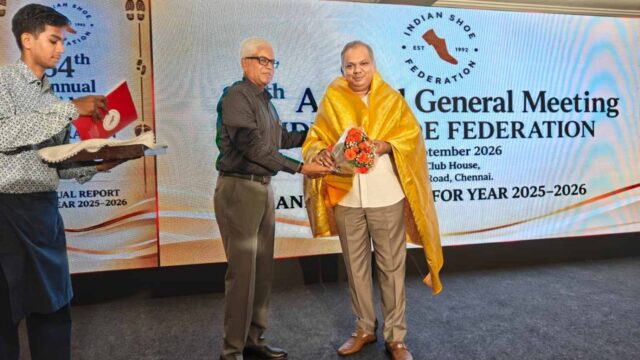
The Indian Shoe Federation (ISF) has appointed Jinnah Rafiq Ahamed, Executive Chairman, Kothari Industrial Corporation Ltd (KICL), as its new Vice President, with effect from September 28, 2026. The appointment was announced at the federation’s 34th Annual General Meeting held in Chennai.
The appointment comes as India’s footwear industry looks to expand its manufacturing and export capabilities while preparing for increased competition and opportunities arising from Free Trade Agreements (FTAs).
Focus on Tamil Nadu footwear ecosystem
Speaking about KICL’s roadmap, Jinnah Rafiq Ahamed, Executive Chairman, Kothari Industrial Corporation Ltd, said the group’s footwear manufacturing initiatives in Perambalur and Karur have contributed to large-scale employment and strengthened the Make in India ecosystem.
“Our journey from our footwear manufacturing initiatives in Perambalur and Karur creating large-scale employment and strengthening the Make in India ecosystem to our new projects in Madurai and Ramanathapuram, reaffirms our Group’s long-term commitment to Tamil Nadu’s footwear and allied industries,” he said.
The company is also developing new projects in Madurai and Ramanathapuram, expanding its footprint in Tamil Nadu’s footwear and allied manufacturing ecosystem.
Design gains importance as FTAs expand access
A key component of the group’s roadmap is its proposed IUAD Italy design education initiative at Hosur. The initiative is aimed at strengthening design capabilities and developing talent for the global footwear market.
Ahamed said India’s expanding network of FTAs could provide greater access to international markets while also increasing competition for domestic manufacturers.
“Design, innovation, product development and global consumer understanding will be critical to converting this opportunity into sustainable growth,” he said.
The collaboration with IUAD Italy at Hosur is intended to bring international design expertise to India and help develop talent capable of addressing global consumer requirements.
Moving beyond manufacturing
The proposed design education initiative reflects a broader shift in the Indian footwear industry, where competitiveness will increasingly depend not only on manufacturing scale but also on product design, innovation and an understanding of international markets.
Ahamed said the objective was to empower Indian talent to “design for the world, not just manufacture for it”.
His appointment to the ISF leadership comes at a time when the industry is seeking to strengthen domestic capabilities, create employment and position India as a more competitive participant in global footwear markets.