


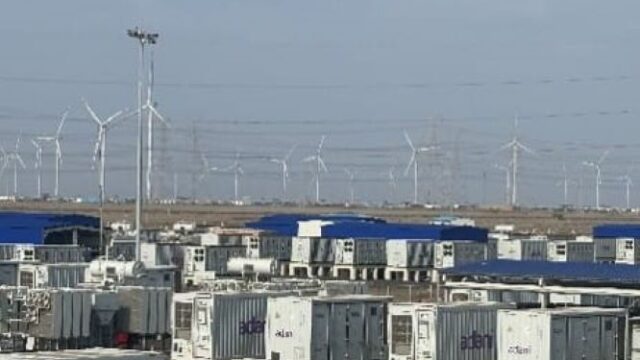
Adani Green Energy Ltd (AGEL), a renewable energy company, has expanded its operational Battery Energy Storage System (BESS) capacity at Khavda in Gujarat to 6.63 gigawatt-hours (GWh) from 3.55 GWh in June 2026.
With this expansion, AGEL accounts for more than half of India’s operational BESS capacity of about 12.6 GWh. The company said the milestone consolidates Khavda’s position as the world’s largest operational battery energy storage installation at a single location.
Storage capacity scaled up rapidly
AGEL achieved the 6.63 GWh milestone within 14 months of commencing on-site BESS construction at Khavda. The latest capacity addition was commissioned within 10 months of the start of its construction.
The BESS is integrated with AGEL’s renewable energy development at Khavda, where the company is developing a 30 GW renewable energy plant across 538 sq km of barren land.
BESS supports renewable integration
The 6.63 GWh BESS can store enough clean energy to power around two million homes for a day and support peak electricity demand in cities such as Nagpur, Patna or Visakhapatnam for several hours.
The storage capacity is equivalent to the battery capacity of more than 1,50,000 mid-sized electric vehicles and can store enough energy daily to meet almost twice the estimated daily electricity requirement of the Delhi Metro.
Storage enables dispatchable clean power
The scale-up is expected to strengthen the integration of renewable energy into the grid by allowing clean power to be stored and dispatched when required.
“At this scale, storage can make renewable power firmer, more reliable and dispatchable when the grid needs it. As India’s power demand grows, we will continue to scale energy storage solutions, both battery and pumped storage, to support a more resilient, lower-carbon grid,” Adani Green Energy, Executive Director, Sagar Adani, said.
AGEL targets 50 GWh storage
AGEL is on track to add more than 10 GWh of BESS capacity in FY27 and is targeting 50 GWh of storage capacity over the next five years.
The company is also pursuing pumped storage projects as part of its broader strategy to build large-scale, firm and dispatchable renewable power capacity.