


Coimbatore-based Ambika Cotton Mills Ltd, a manufacturer of cotton yarn and knitted fabrics, is evaluating opportunities in Battery Energy Storage Systems (BESS) while planning to invest approximately ₹135–138 crore in modernising its Unit 4, to be operational by March 2027.
The company is assessing BESS opportunities based on technical feasibility, investment economics, operating requirements and the regulatory environment. The initiative forms part of its broader focus on renewable energy, energy efficiency and long-term manufacturing resilience.
Modernisation to improve efficiency
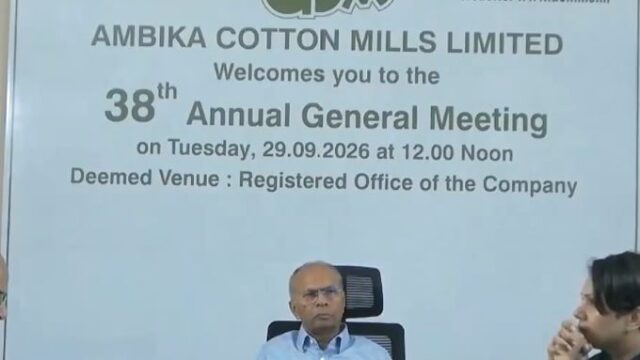
The proposed modernisation will replace 43,000 existing spindles with 45,000 new-generation spindles. The investment will be funded entirely through internal accruals, Chairman P.V. Chandran said at the company’s 38th Annual General Meeting.
“The objective is not merely to increase capacity but to improve productivity, automation, process control, product consistency and manpower efficiency,” he said.
Technology drives capital allocation
“We do not want to become larger merely for the sake of becoming large. We want to become better, more productive, more automated, more energy-efficient and more resilient,” he said.
The debt free company capital allocation strategy remains focused on investments that can improve productivity, technology, product differentiation and long-term competitiveness.
BESS evaluation gains focus
According to him, the company’s sustainability approach is centred on investments in renewable energy and energy efficiency that can contribute to environmental objectives while improving the resilience and competitiveness of its manufacturing operations.
“The proposed Unit 4 modernisation reflects this approach, with the focus on improving the quality, productivity and efficiency of its manufacturing base rather than pursuing expansion merely for scale,” he said.
Strategy targets value-added products
The company’s strategy centres on quality and consistency, technology and automation, product differentiation, customer-specific product development, operational efficiency and disciplined capital allocation.
“Going forward, our plan is to focus on technology-led modernisation, premium and value-added products, customer-specific innovation, enduring export relationships and renewable energy,” he said.
Revenue and profit rise
In Q1 FY27, ACML reported revenue from operations of ₹258 crore against ₹192 crore in the corresponding quarter last year.
Net profit increased to ₹26 crore from ₹16 crore, due to a resurgence in global demand along with capacity expansion.
Spindle capacity reaches 120,816
Last year, ACML invested ₹70 crore on modernisation, entirely through internal accruals. Its installed spindle capacity increased from 108,288 to 114,336 during the year.
A further 6,480 spindles were commissioned on September 26, taking total installed capacity to 120,816 spindles.
Aware of external factors
The company remains conscious of external factors affecting the textile industry, including raw-material prices, currency movements, competitive pressures and global economic conditions.
ACML ambition is to build a stronger, more efficient and more valuable business, with long-term value creation for customers and shareholders remaining a key focus.