


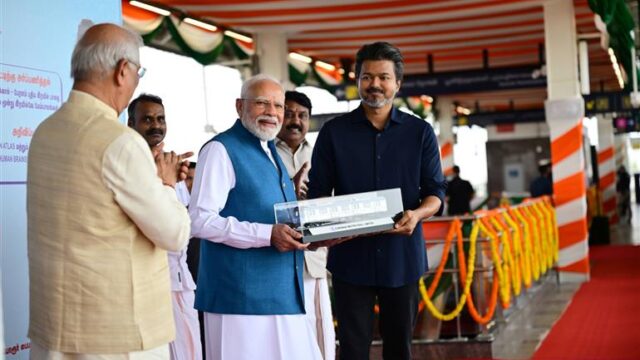
Prime Minister Narendra Modi on Sunday inaugurated, dedicated to the nation and laid the foundation stone for development projects worth more than ₹13,000 crore in Tamil Nadu, with a focus on urban mobility, road and rail connectivity, industrial expansion and employment generation.
The projects are expected to improve connectivity, reduce travel time in Chennai and other parts of the state, strengthen industrial supply chains and create employment opportunities, particularly for young people, Modi said.
Addressing a gathering in Chennai, the Prime Minister said infrastructure development would support Tamil Nadu’s manufacturing and services sectors by improving the movement of raw materials and finished goods. He also highlighted the Centre’s efforts to expand domestic manufacturing, strengthen port infrastructure and reduce dependence on imports.
Chennai Metro expansion to improve urban mobility
Modi dedicated an additional stretch of the Chennai Metro to the public, highlighting the role of mass rapid transit systems in accommodating urbanisation and reducing commuting difficulties.
The prime minister inaugurated the Poonamallee-Vadapalani stretch of Chennai Metro Phase 2 on Sunday, October 11, 2026. The new corridor is expected to improve connectivity between Chennai’s western suburbs and the city centre.
The 15-km-long stretch has 11 elevated metro stations. It is part of Corridor 4 of Chennai Metro Phase 2, also known as the Yellow Line.
The corridor features a 3.7-km double-decker structure and advanced signalling systems designed to support driverless train operations. The new metro service is expected to reduce travel time for commuters and make daily journeys easier.
He said the expansion of India’s metro network reflected the country’s broader infrastructure development. According to the Prime Minister, metro services, which were operational in five cities in 2014, are now available in 25 cities. The national metro network has expanded from around 250 km to more than 1,100 km over the same period, he said.
Modi stressed that urban development required an integrated approach encompassing public transport and other infrastructure, rather than relying solely on road widening.
Improved public transport, he said, would reduce travel time and enhance the ease of living for urban residents.
Manufacturing push to support jobs and reduce imports
The Prime Minister highlighted Tamil Nadu’s contribution to India’s manufacturing sector, citing its industrial base, small enterprises and workforce.
He said initiatives such as Make in India and Vocal for Local had helped strengthen domestic manufacturing capabilities. India has become the world’s second-largest mobile phone manufacturer, while electronics exports have increased elevenfold since 2014, according to Modi.
He also pointed to a 50-fold increase in defence exports and record engineering exports, linking the expansion of manufacturing to employment creation across the country.
The Prime Minister announced the foundation stone for an advanced lubricant base oil project, saying it would generate local employment and help reduce India’s import dependence.
He emphasised that manufacturing growth depended on efficient roads, railways and ports, which facilitate the movement of industrial inputs and finished products. Infrastructure construction also generates demand for cement, steel, equipment and engineering services, creating employment across multiple sectors, he said.
VOC Port development to strengthen maritime logistics
Port-led development was another major focus of the Prime Minister’s address.
Modi referred to a proposed investment of around ₹17,000 crore to transform V.O. Chidambaranar (VOC) Port in Thoothukudi into a mega container and green energy hub capable of handling ultra-large container vessels.
The proposed development is intended to strengthen Tamil Nadu’s position in maritime logistics and international trade, he said.
The Prime Minister also highlighted improvements in the operational efficiency of Indian ports, noting that a reduction in ship turnaround times had helped domestic products reach international markets faster.
Improved port infrastructure, combined with road and rail connectivity, would support industrial growth and strengthen the state’s integration with global supply chains, he said.
Fisheries infrastructure and cold chain development
Modi highlighted the Centre’s support for Tamil Nadu’s fisheries sector under the Pradhan Mantri Matsya Sampada Yojana and other schemes.
He said funds had been approved for upgrading fishing harbours, developing fish landing centres and strengthening cold chain infrastructure. Support had also been extended for purchasing transport vehicles to preserve the freshness of fish during transportation.
The Prime Minister cited the modernisation of Chennai Fishing Harbour and the proposed development of a seaweed park in Tamil Nadu as initiatives aimed at expanding opportunities in the coastal economy.
He also referred to the availability of working capital for fishermen through the Kisan Credit Card scheme.
According to Modi, the expansion of fish production and the increase in seafood exports to record levels in terms of both volume and value in the previous year had improved prospects for fishing communities.
Infrastructure investment and employment generation
The Prime Minister said the benefits of infrastructure investment extended beyond the immediate construction phase.
Road and rail projects generate employment for engineers, technicians and construction workers while creating demand for materials and services supplied by smaller companies. Once operational, these projects can improve logistics efficiency and support the expansion of manufacturing, trade and services.
He said the development projects launched in Tamil Nadu would contribute to the state’s economic progress by improving connectivity and strengthening its industrial ecosystem.
Modi reiterated that the Centre’s development approach was based on the principle that national growth depended on the development of individual states.
He also highlighted the importance of cooperative federalism, saying his experience as Gujarat Chief Minister had shaped his understanding of state-level development priorities.
Heritage and modern infrastructure
The Prime Minister linked Tamil Nadu’s cultural heritage with its contemporary development ambitions, referring to his visit to the Jalakandeswarar Temple and the Brain Research Centre at IIT Madras.
He said the combination of heritage conservation, scientific research and modern infrastructure reflected India’s development priorities.
Modi also noted that he had completed 25 consecutive years as head of a government, beginning with his first oath as Gujarat Chief Minister in October 2001. He said the experience had reinforced his belief in cooperative federalism and development driven by the aspirations of individual states.
Concluding his address, the Prime Minister said the Centre would continue to support Tamil Nadu’s development and called for coordinated efforts to achieve the vision of a developed India through a developed Tamil Nadu.