


The BHAVYA scheme will follow a challenge-based competitive framework under which states will submit detailed project proposals highlighting their industrial strengths, land availability, investor interest and sectoral potential.
The Centre will work closely with industry stakeholders to identify the most suitable sectors and infrastructure requirements for each location, whether for manufacturing, chemicals, data centres or other industries.
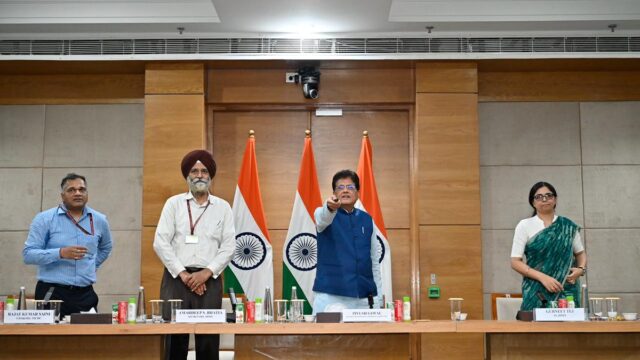
Speaking at the launch of BHAVYA portal, in New Delhi, Union Minister of Commerce & Industry, Piyush Goyal said investors will be able to access detailed information on industrial parks through digital platforms, including land availability, connectivity and surrounding infrastructure, enabling informed investment decisions.
Parks of different sizes planned
Goyal said the scheme aims to create 100 industrial parks across India with sizes tailored to regional requirements.
Under the plan, parks in hilly regions, smaller Union Territories and Northeastern states could be developed on as little as 25 acres, while parks in mid-sized states may range from 100 to 500 acres. Larger industrial parks of up to 1,000 acres could be established near cities and urban centres depending on demand and state commitments.
Land for the parks will be provided by state governments, while infrastructure development will be supported through the National Industrial Corridor Development Corporation under a 51:49 partnership model with states.
Focus on plug-and-play infrastructure
The industrial parks are planned as plug-and-play facilities equipped with assured water and power supply, road and rail connectivity, clear land titles and digital single-window approvals.
The government is also exploring the creation of dedicated zones for startups, deep-tech enterprises, research and development activities and innovation-driven businesses.
In addition, modern testing facilities are proposed in collaboration with organisations such as Bureau of Indian Standards, Export Inspection Agency and Food Safety and Standards Authority of India to provide investors with access to advanced testing infrastructure within the parks.
Faster approvals for investors
Goyal said the initiative is designed to reduce the time investors spend on land acquisition and regulatory approvals by providing ready infrastructure and streamlined clearances.
Environmental approvals and industry-specific requirements will be planned in consultation with relevant authorities based on the suitability of each location.
The government is also considering dedicated areas for Global Capability Centres (GCCs), worker housing and social infrastructure within the industrial parks.
International investment focus
The minister said India could explore dedicated international enclaves in partnership with countries including Japan, Singapore, Republic of Korea and Switzerland to facilitate investments and provide a familiar environment for expatriate professionals working in India.
He noted that India is increasingly being viewed as a trusted global investment destination due to its scale, growing domestic demand, young talent pool and ongoing economic reforms.
Portal to drive implementation
The BHAVYA portal, developed by NICDC, will function as a single digital interface for the end-to-end implementation of the scheme.
The platform will facilitate submission of Detailed Project Reports (DPRs), project appraisal, evaluation and real-time monitoring of implementation progress. It will also support transparent assessment of proposals submitted by states, Union Territories and implementing agencies.
Applications received between June 1 and July 31 will be considered for the first phase comprising 20 industrial parks, while another 30 parks will be selected from applications received up to September 30. Subsequent phases will be rolled out based on learnings from the initial rounds.
Goyal expressed confidence that the scheme would catalyse significant investments, create direct and indirect employment opportunities and contribute to the vision of Viksit Bharat 2047 through a new phase of industrial development across the country.