


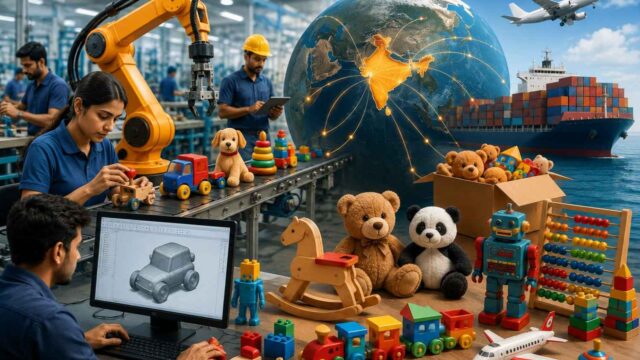
India’s toy industry is undergoing one of the most significant transformations in its history. Once heavily dependent on imports, the sector is now emerging as a domestic manufacturing success story, backed by government policy, stricter quality norms and rising exports. But the next phase of growth will depend less on protection and more on competitiveness, branding and technology.
That was the central message from Union Commerce and Industry Minister Piyush Goyal while addressing the 17th Toy Biz International B2B Exhibition 2026 in New Delhi. Rather than celebrating the industry’s recent gains alone, the Minister outlined what will be required for India to secure a meaningful share of the global toy market, estimated at around $120 billion.
A sector transformed in five years
The numbers illustrate the industry’s rapid evolution. According to the government, toy exports have jumped 239% over the last four years, while imports have declined by 32%. The domestic market, estimated at around ₹18,000 crore, is now largely supplied by Indian manufacturers, with imports accounting for only about ₹2,500-3,000 crore. Just a few years ago, domestically manufactured toys accounted for only around 12% of the Indian market.
The turnaround has been driven by the Make in India initiative, the National Toy Action Plan launched in 2020, Quality Control Orders (QCOs) and the development of more than 50 toy clusters across the country. Today, nearly 21,000 MSMEs are engaged in toy manufacturing, many producing for both Indian and international brands.
The next challenge is quality, not quantity
Despite the industry’s progress, the government’s focus is now shifting from capacity expansion to quality enhancement.
Goyal announced that modern testing facilities will be established across toy manufacturing clusters through the Bureau of Indian Standards (BIS), National Test House and other laboratories. Manufacturers have been asked to identify the testing equipment required to certify products for durability, paint quality, finishing and electronic safety.
The emphasis reflects a broader shift in India’s manufacturing strategy, moving from import substitution to globally competitive production. According to the Minister, sustained improvements in materials, finishing, safety standards and manufacturing processes will determine whether Indian companies can compete with established international brands.
Technology and design move to the forefront
The government is also encouraging the industry to embrace advanced manufacturing technologies. Manufacturers have been urged to adopt CAD-CAM systems, CNC machining and automated production processes to improve precision, consistency and productivity. The proposal to establish public-private Centres of Excellence for design, testing, innovation and product development indicates that future competitiveness will depend increasingly on design capabilities rather than low-cost manufacturing alone.
Industry-led skill development centres, in partnership with Industrial Training Institutes (ITIs), have also been proposed to address the growing demand for a skilled manufacturing workforce.
FTAs create a new export opportunity
While domestic demand remains strong, the government’s long-term strategy clearly centres on exports. India’s recently concluded Free Trade Agreements are expected to provide toy manufacturers with preferential access to developed markets. Goyal highlighted duty-free opportunities in Europe and noted that the India-UK Free Trade Agreement will become operational from July 15, creating immediate opportunities for exporters.
The Minister also pointed to Australia, New Zealand and future trade agreements with GCC countries, Mexico, Brazil and Canada as potential growth markets. He urged companies to actively build international brands, participate in overseas exhibitions and establish warehousing facilities abroad to improve delivery timelines and customer service.
Scaling up remains the missing piece
Another structural challenge for the sector is scale. Although India has around 21,000 toy manufacturers, most remain MSMEs. Goyal encouraged enterprises to continuously expand, reminding them that export turnover is excluded while determining MSME status, allowing companies to grow without immediately losing policy benefits.
He also called on the Toy Association of India to broaden its membership beyond its current base of around 1,200 members, arguing that a stronger industry platform would help manufacturers collaborate on technology, exports, branding and policy issues.
Building global brands will define the next decade
India’s toy industry has clearly moved beyond its dependence on imported products. Policy support, quality regulations and manufacturing incentives have laid the foundation for sustained growth.
However, the next phase will require manufacturers to compete on innovation, design, safety, branding and technology rather than price alone. Capturing a larger share of the $120-billion global toy market will depend on whether Indian companies can evolve from contract manufacturers into globally recognised consumer brands.
For an industry that has already demonstrated its ability to reverse import dependence, that may well be the next, and most important, milestone.