


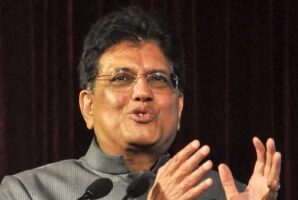
India and Russia need to accelerate the diversification of their economic relationship beyond energy if bilateral trade is to rise from around $60 billion currently to $100 billion by 2030, Union Commerce and Industry Minister Piyush Goyal said on Thursday.
Addressing the INNOPROM India 2026 Co-Chair Plenary Session in New Delhi alongside Russian Minister of Industry and Trade Anton Alikhanov, Goyal called on businesses in both countries to convert the political commitment between the two sides into concrete trade and investment projects.
The $100 billion trade target would require an additional $40 billion over the next four years, implying sustained double-digit growth in bilateral trade. Goyal said this would have to be driven not only by governments but also by businesses on both sides.
Moving beyond energy
The biggest challenge for the bilateral trade relationship is its concentration in energy, with non-energy trade still substantially below its potential. Goyal said expanding Indian exports across pharmaceuticals, engineering goods, chemicals, textiles, food, marine products and automobiles would be critical to rebalancing trade.
Recent export trends suggest that there is already a market for a wider range of Indian products in Russia. Indian exports of meat and edible meat products more than doubled from $36 million to $97 million, while fish and aquatic products rose from $123 million to $159 million.
Exports of edible vegetables increased from $38 million to $54 million, while coffee, tea and spices rose 13% to $116 million. Products of the milling industry also nearly doubled.
Investment needs to become two-way
Goyal also sought a more balanced investment relationship, setting the stage for Indian companies to expand their presence in Russia while encouraging Russian companies to manufacture in India.
The India-Russia priority investment projects mechanism is currently tracking 40 live projects spanning advanced manufacturing, energy, mining, railways and emerging technologies.
Goyal called on Russia to facilitate greater Indian investment in areas such as pharmaceuticals, IT, artificial intelligence, services, engineering and railways. The objective, he said, is to ensure that the proposed $50 billion two-way investment target by 2030 is genuinely reciprocal.
India’s industrial corridors, he said, offer plug-and-play infrastructure for global investors, while the country’s large pool of young and skilled talent provides another advantage for Russian companies.
Investment treaty and EAEU trade talks
India and Russia are also fast-tracking negotiations for a new bilateral investment treaty aimed at providing greater legal certainty to investors on both sides.
Goyal said India and the Eurasian Economic Union, comprising Russia, Belarus, Kazakhstan, Armenia and the Kyrgyz Republic, had also launched formal free trade negotiations last year.
An early conclusion of the negotiations could give Indian companies, particularly MSMEs, access to a wider market beyond Russia.
Payments and connectivity
The two countries are continuing efforts to strengthen settlement mechanisms using national and local currencies, an issue Goyal described as critical to easing friction in bilateral commerce.
Payment difficulties, he said, can often become a bigger obstacle to trade than tariffs.
Physical connectivity is another part of the strategy. Goyal highlighted the International North-South Transport Corridor and the Chennai-Vladivostok maritime corridor as important components of the economic relationship.
Five asks from
put forward five specific expectations from businesses and officials.
He first urged companies attending the event to conclude at least one deal before leaving Delhi, establish a new business relationship and take forward at least one concrete project.
Second, businesses were asked to add new non-energy sectors to their trade and investment plans, particularly pharmaceuticals, engineering goods, chemicals, auto components, tractor parts, textiles, food, agri-tech and marine products.
Third, Goyal urged Russian industry to manufacture in India rather than limiting its presence to product sales.
Fourth, he called on Indian companies to approach Russia not merely as visitors or exporters but as potential investors, partners and long-term participants in the Russian market.
Finally, he asked officials from both countries to work directly with industry to identify the practical barriers holding back trade and investment.