


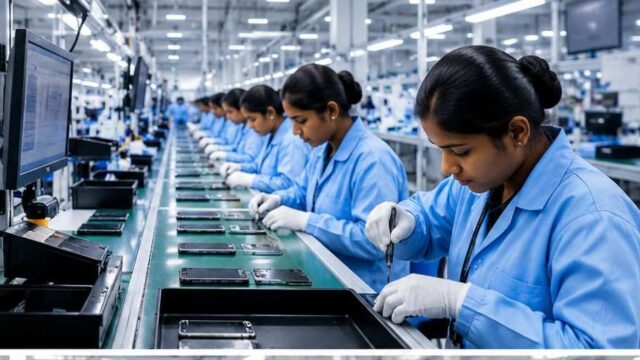
At a sprawling electronics manufacturing campus in Hosur, Tamil Nadu, thousands of young women assemble smartphones and electronic components that eventually find their way into markets across the world. Dressed in clean-room uniforms and working on sophisticated production lines, they represent a quiet but significant shift taking place in India’s manufacturing landscape.
Few states illustrate this transformation better than Tamil Nadu. Manufacturing hubs such as Hosur and Sriperumbudur have become central to India’s global electronics ambitions, attracting investments from leading multinational companies and contract manufacturers
Manufacturing becomes a major employment engine
India’s electronics manufacturing industry has evolved into one of the country’s biggest employment creators.
Over the past decade, the sector has generated nearly 25 lakh jobs, making it one of the fastest-growing contributors to manufacturing-led economic growth.
The mobile phone ecosystem alone now supports nearly 12 lakh direct and indirect jobs, spanning component manufacturing, assembly, logistics, testing and ancillary industries.
Government initiatives led by the Ministry of Electronics and Information Technology (MeitY) have further accelerated employment generation. Flagship programmes, including the Production Linked Incentive (PLI) scheme, have created more than 5.3 lakh jobs, including around 1.8 lakh under the electronics PLI programme.
Organised employment generators
The growth has transformed electronics manufacturing into one of India’s largest organised employment generators.
Combined with manufacturing facilities in Bengaluru, the Hosur and Sriperumbudur clusters now provide quality employment to more than one lakh people, producing smartphones and electronic products for domestic and international markets.
The ecosystem extends far beyond final assembly, supporting component suppliers, logistics providers, packaging companies, tooling manufacturers and engineering services.
This growing network has significantly strengthened India’s domestic manufacturing capabilities while reducing dependence on imports.
Women move to the centre of manufacturing growth
Perhaps the most remarkable feature of India’s electronics revolution is the increasing participation of women. Unlike many traditional manufacturing sectors, electronics production has become one of the country’s most women-intensive industries.
Women account for nearly 30% of all employment generated by the electronics manufacturing sector during the past decade.
In mobile phone manufacturing, the numbers are even more striking. Women now comprise nearly 70% of the direct workforce, making smartphones one of India’s largest formal employment avenues for young women.
Several large electronics manufacturing facilities across India report women constituting the majority of their workforce.
One of India’s largest electronics manufacturers employs nearly 80,000 people across three manufacturing facilities, with women accounting for around 65% of its workforce.
The trend reflects not only changing hiring practices but also the industry’s focus on creating safe workplaces, structured training programmes and long-term career opportunities.
For many young women entering the workforce, these jobs provide financial independence, skill development and greater social mobility.
India’s electronics story moves beyond assembly
The country’s electronics success is no longer limited to assembling imported components. India’s manufacturing ecosystem has become deeper and more integrated over the past decade.
More than 40 major component manufacturers have either established or expanded operations in India, supported by a rapidly growing network of Tier-2, Tier-3 and Tier-4 suppliers.
As a result, domestic value addition in electronics manufacturing has improved from 15% to 23%, reflecting stronger local supply chains and greater indigenous manufacturing capability.
This localisation is expected to increase further as investments continue across semiconductor components, printed circuit boards, camera modules, displays and battery systems.
A decade of remarkable growth
Government initiatives such as Make in India and Atmanirbhar Bharat have fundamentally reshaped India’s electronics industry. Electronics production has expanded from ₹1.90 lakh crore in FY15 to an estimated ₹13.11 lakh crore in FY26, representing nearly a seven-fold increase.
Exports have grown even faster. Electronic goods exports increased from ₹38,263 crore to ₹4.24 lakh crore during the same period, an eleven-fold jump.
Today, electronics has become India’s third-largest export category, with overseas shipments touching USD 47.96 billion during FY26.
Mobile phones become India’s biggest export
The biggest success story within the sector has been mobile phone manufacturing. India has transformed itself from a net importer of smartphones into the world’s second-largest mobile phone manufacturing hub.
Mobile phone production has grown dramatically from ₹18,900 crore in FY15 to ₹6.27 lakh crore in FY26, representing a 33-fold increase.
Exports have expanded even faster. Mobile phone exports surged from just ₹1,566 crore in FY15 to ₹2.60 lakh crore in FY26, a remarkable 165-fold growth.
Reflecting this transformation, mobile phones have climbed from being India’s 153rd-largest export item a decade ago to become the country’s largest export product today. The achievement underlines India’s growing competitiveness in global electronics manufacturing.
PLI scheme accelerates investment
The Production Linked Incentive (PLI) scheme has emerged as one of the biggest catalysts behind this transformation. As of March 31, 2026, the scheme had attracted cumulative investments exceeding ₹20,600 crore, surpassing its original targets.
Manufacturing output under the programme has crossed ₹11.62 lakh crore, while exports have exceeded ₹6.53 lakh crore.
The policy has encouraged both multinational corporations and domestic manufacturers to establish large-scale production facilities in India while integrating the country into global supply chains.