


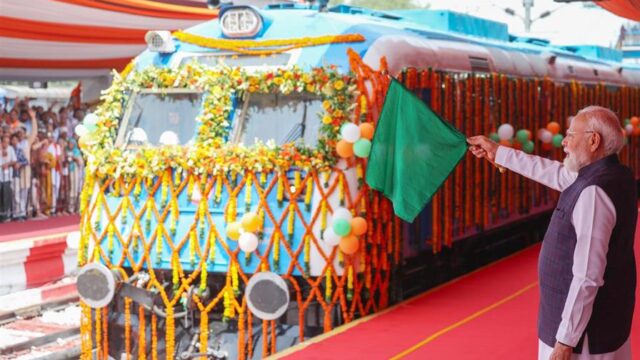
Prime Minister Narendra Modi on Friday flagged off India’s first hydrogen-powered train, describing it as the world’s most powerful and longest hydrogen train, and said the project marks a significant leap in the country’s clean mobility ambitions under the Make in India initiative.
The hydrogen train will initially operate on the 90-km Jind-Sonipat route in Haryana and is expected to serve as a pilot for the future expansion of hydrogen-powered rail services in the country.
World’s most powerful hydrogen train
Addressing the gathering after the launch, Modi said India’s first hydrogen train has a 3,200-horsepower engine, making it the most powerful hydrogen-powered train currently in operation anywhere in the world.
He also highlighted that the train comprises 10 coaches, making it the longest hydrogen train globally.
“In many countries, hydrogen trains operate with only three or four coaches. India, in its very first attempt, has introduced a 10-coach hydrogen train, setting a global benchmark,” he said.
Make in India success
The Prime Minister said the project reflects India’s growing technological capabilities and manufacturing strength.
He noted that the hydrogen train has been designed by Indian engineers and manufactured by an Indian company, making it another significant achievement under the government’s Make in India programme.
Besides being emission-free, the train represents India’s ability to develop advanced transportation technologies domestically, he added.
Dedicated hydrogen infrastructure planned
Modi said hydrogen-powered trains require specialised infrastructure that is significantly different from conventional rail systems.
He said the necessary hydrogen ecosystem has already been created at Jind, with additional infrastructure planned as the hydrogen rail network expands.
The expansion will include new facilities and manufacturing units to support hydrogen train operations, creating fresh employment opportunities, particularly for the youth of Haryana.
India enters new era of rail technology
Drawing parallels with the evolution of railway technology, the Prime Minister said the 19th century belonged to steam locomotives, while the 20th century was defined by diesel and electric trains.
“The 21st century will be known for hydrogen-powered trains,” he said, adding that Indian Railways has taken a decisive step towards adopting next-generation green transport technologies.
Expansion on the cards
The Prime Minister said the hydrogen train will initially operate over a 90-km stretch between Jind and Sonipat, but the technology offers significant scope for expansion across the Indian Railways network.
He said the government will continue research and development to reduce costs, improve efficiency and evaluate the technology before scaling up deployment.
According to Modi, hydrogen-powered rail technology has emerged globally only over the past seven to eight years, with only a handful of countries currently operating such trains.
He said India’s entry into this exclusive group demonstrates the country’s growing technological capabilities and reinforces its ambition to become a global leader in sustainable transportation.